
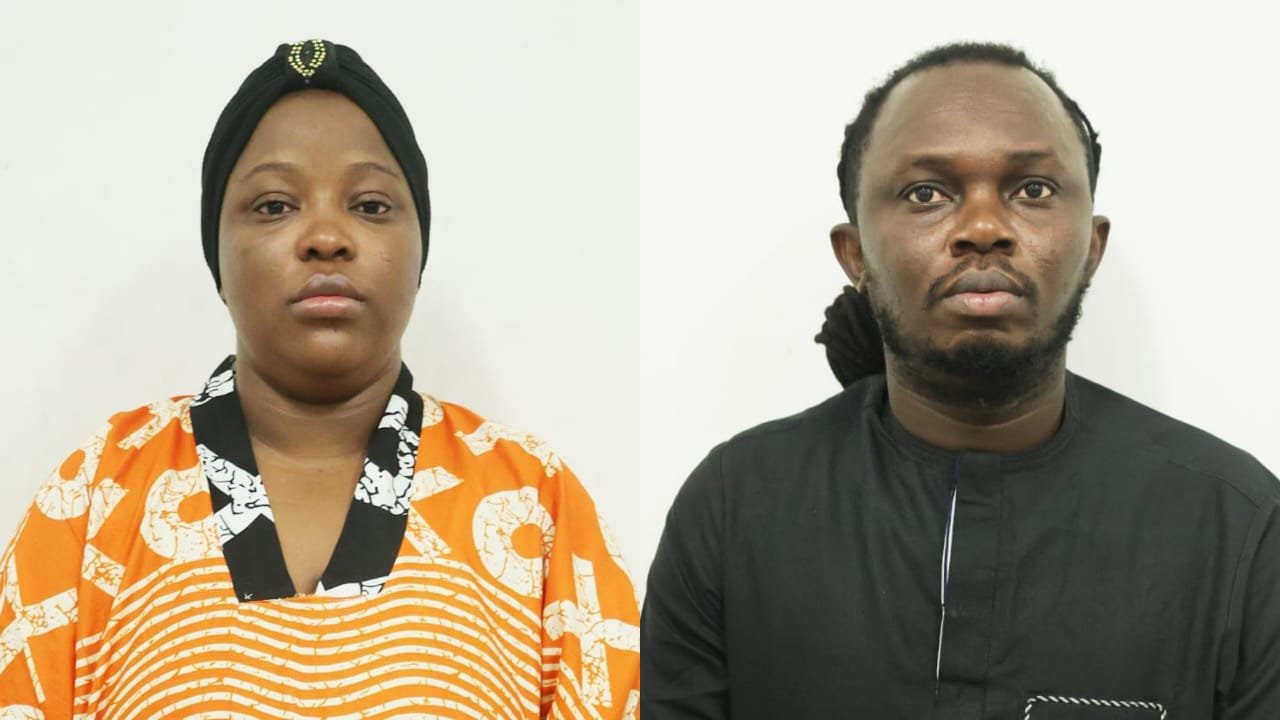
The Economic and Financial Crimes Commission (EFCC) on Monday arraigned Osabohein Ologbose and his wife, Hope Oghelemu, over an alleged N740 million investment fraud.
They were arraigned before Ekerete Akpan of the Federal High Court in Abuja alongside two companies, Onome Global Market Resources Limited and Lexicon Multi-Concept Media Limited,
They pleaded not guilty to seven counts of obtaining money by false pretence, conversion of funds, and money laundering brought against them by the prosecution.
EFCC said the offences contravened Section 18(2)(b) of the Money Laundering (Prevention and Prohibition) Act, 2022.
According to the amended charges filed on 28 January 2026, the EFCC alleged that Mr Ologbose, between January 2023 and April 2024, took possession of N340 million paid into his Kuda Microfinance Bank account by Mss Oghelemu, knowing the funds were proceeds of unlawful activity.
Another count accused him of using N24.1 million—also allegedly sourced from unlawful proceeds—to establish and operate a music and photo studio at Crowther Plaza in Abuja.

The defendants pleaded not guilty to all charges.
The EFCC spokesperson, Dele Oyewale, disclosed the development in a statement issued on Monday.
Bail request
Following their plea, EFCC counsel O.S. Ujam requested a date for the commencement of trial. Defence counsel, Marshal Abubakar, urged the court to allow Mr Ologbose to continue on the administrative bail earlier granted by the EFCC. He also sought bail for Ms Oghelemu, citing the need for her to care for her one-year-old baby.
The judge granted bail to the first defendant but denied the third defendant’s bail request. Ms Oghelemu was ordered to be remanded at the Suleja Correctional Centre. The case was adjourned until 27 April for trial..
EFCC probe
EFCC said its investigation revealed that the defendants allegedly lured several Nigerians to invest in a scheme purportedly involving the procurement and export of bitter kola and red kolanut to Hong Kong, China, and Indonesia, with promises of attractive returns on investment (ROI).
The anti-graft agency said investors neither received their promised ROI nor had their capital refunded.