
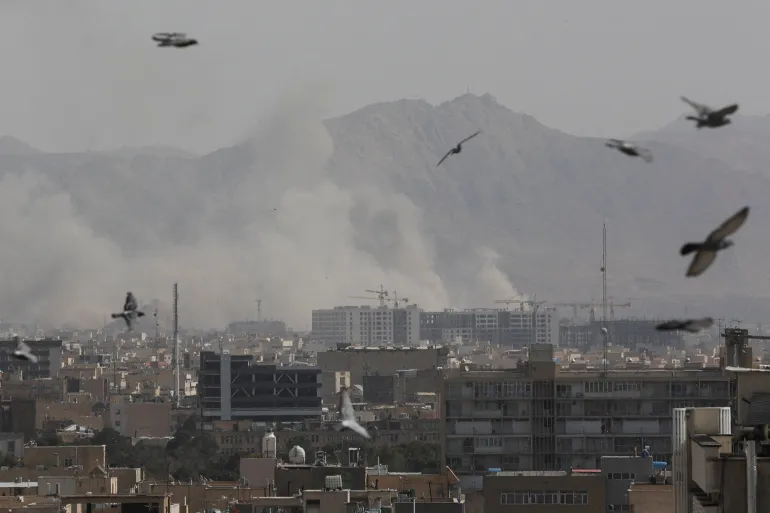
The war between the United States and Israel against Iran entered its ninth day and second week today (Sunday).
Strikes are intensifying, casualties rising, with the majority of them in Iran. More than 1,300 people have been confirmed dead as a result of continuous strikes.
We bring you major updates on the war on its eighth day.
Attacks on Gulf states continue despite apology
Saudi Arabia, Qatar, and Kuwait all reported new attacks, a day after Iran issued an apology for previous attacks, and promised to no longer attack except when an attack is launched from the territories first.
Two border guards died on Sunday after a barrage of Iranian drones and missiles hit Kuwait.
A drone also struck fuel tanks at Kuwait International Airport, triggering a major fire.

Announcing the impact of the strikes, the Gulf nation’s Defence Ministry said, “The fuel tanks of Kuwait International Airport were attacked by drones in a direct targeting of vital infrastructure.”
The Kuwaiti interior ministry also said two border guards “were martyred… while performing their national duty.”
The military said it had intercepted the “hostile missile and drone attacks.”
“Kuwaiti air defences are currently engaging hostile missile and drone attacks,” the military said in a post on X.
Kuwait’s national oil company also announced a “precautionary” cut to its crude production.
Similarly, Qatar’s defence ministry stated that the country was targeted a day earlier by 10 ballistic missiles and two cruise missiles fired from Iran.
It noted the missiles were intercepted, and the debris from the aerial intervention fell on a car in the Al Barsha area, resulting in the death of a Pakistani driver.
Saudi Arabia’s defence ministry also reported intercepting and destroying 15 drones that entered the kingdom’s airspace, including an attempted attack at the diplomatic quarter in Riyadh.
Disagreement over Pezeshkian’s apology
As Iran reels under US and Israeli bombardment, cracks have begun to emerge in its leadership.
President Masoud Pezeshkian’s apology to neighbouring Gulf states triggered a mix of reactions between the country’s hardliners and its more pragmatic factions.
PREMIUM TIMES reported that in a televised address, Mr Pezeshkian had apologised to neighbouring countries affected by Iranian strikes and urged them not to join US-Israeli attacks on Iran.
Mr Trump took credit for the new policy, saying it “was only made because of the relentless US and Israeli attack.”
But Mr Pezeshkain’s comment triggered a backlash from hardliners in the state.
Reuters reports that an Iranian lawmaker and cleric, Hamid Rasai, described Mr Pezeshkian’s statement as “unprofessional, weak and unacceptable”
Also, a member of the three-person interim leadership council, Gholamhossein Mohseni-Ejei, said evidence shows that “the geography of some regional countries has openly and covertly been placed at the disposal of the enemy” and used for attacks on Iran.
He declared that intense attacks on such locations “would continue” and that “this strategy is currently being implemented and the government and other pillars of the system are united on this matter.”
The temporary three-member leadership council coordinates the operational command of Iran’s armed forces, including both the regular army and the IRGC.
The council is currently exercising powers normally held by the country’s supreme leader in wartime.
Iranian hardliners insist that any state used to launch attacks against Iran would be considered a legitimate target.
Reuters also said Mr Pezeshkian later repeated his message on social media, omitting the apology.
Trump vows to hit Iran harder
President Donald Trump, on Saturday, declared that he had no interest in negotiations, even though he had “maximum leverage.”
Mr Trump said negotiations would become irrelevant if all potential leaders in Iran were eliminated and the country’s military was destroyed.
He added that the war would only end once Tehran no longer had a functioning military or any remaining leadership.
“We don’t want to come back every five or 10 years and do this… We want to pick a president who’s not going to lead their country into a war.
“At some point, I don’t think there will be anybody left, maybe to say ‘We surrender,” Mr Trump said.
The US also appears to have changed its stance on Kurdish rebels, with Mr Trump stating that the country is “not looking to the Kurds going in” and that “we don’t want to make the war more complex than it already is.”
Slain American soldiers returned home
On Saturday, the corpse of the six American soldiers killed by Iranian strikes in Kuwait arrived in the US.
Mr Trump, as the commander-in-chief of the US military, presided over the arrival ceremony of the slain soldiers.
He described their deaths as a “very sad day” for the Americans.
This ceremony is regarded as the “dignified transfer.”
Meanwhile, the US Defence Secretary, Pete Hegeseth, said the US will retaliate for the murder of any American citizen.
“If you kill Americans, if you threaten Americans anywhere on earth, we will hunt you down without apology and without hesitation, and we will kill you,” he was quoted as saying in a post by CENTCOM on X.
Trump rejects UK’s offer to send aircraft carriers
Meanwhile, Mr Trump had rejected the UK’s offer to send two aircraft carriers to the Middle East.
This comes after the UK Ministry of Defence announced that it was preparing an aircraft carrier for possible deployment.
The UK said its aircraft were flying over Jordan, Qatar and Cyprus to “defend British interests.”
But Mr Trump appears to be displeased with London’s initial hesitation.
In a post on Truth Social, Mr Trump said, “The United Kingdom, our once Great Ally, maybe the Greatest of them all, is finally giving serious thought to sending two aircraft carriers to the Middle East. That’s OK, Prime Minister Starmer, we don’t need them any longer,” he said.
“But we will remember,” he added. “We don’t need people who join wars after we’ve already won.”
Days earlier, Mr Trump had condemned the UK and Spain for their stances on the war.
Spain refused to allow America to use its bases, which Mr Trump said was necessary to “eradicate potential attack by an unstable regime.”
Mr Trump also criticised the UK’s deal to give the Chagos Islands, home of the joint US-UK military base on Diego Garcia, back to Mauritius.
Prime Minister Keir Starmer had initially said his government “does not believe in regime change from the skies.”
Iran mocks Trump’s demand for unconditional surrender
Iran, on Saturday, also mocked Mr Trump’s call for “unconditional surrender.”
The US president had earlier demanded that the Iranian leadership fully surrender to the US for the war to end.
He had also called for the selection of a supreme leader acceptable to the US and Israel, following the death of Ali Khanemei in the joint US-Israel strike first launched on 28 February.
We and many of our wonderful and very brave allies and partners will work tirelessly to bring Iran back from the brink of destruction, making it economically bigger, better, and stronger than ever before,” he said.
“Iran will have a great future. “Make Iran Great Again (MIGA!),” he added.
However, responding to this, Iranian President, Mr Pezeshkian, labelled the president’s demand a “dream that they should take to their grave.”
Israel targets Iran’s fuel depot
Late Saturday, Israel expanded its military campaign by striking fuel depots close to Tehran.
This is the first attack on Iran’s energy infrastructure since the war began last weekend.
READ ALSO Hoodlums attack LG congresses of Wike’s PDP faction in Oyo
According to the Israeli Prime Minister Benjamin Netanyahu, the strikes on the fuel depots were part of a broader effort to hit “many more targets” aimed at destabilising Iran’s government and creating conditions that could “allow for change.”
The Israeli military said the depots were targeted because Iran’s armed forces were using them.
However, an Iranian leader, Ali Larijani, said the country would continue retaliatory attacks and warned that its enemies would “pay the price” for targeting the nation.
But Mr Trump, responding to this threat, said, “I have no idea what he’s talking about, who he is. I couldn’t care less.”