
A group of Nigerian civil society activists, academics, and legal practitioners has warned against foreign military involvement in Nigeria, arguing that such actions could undermine national sovereignty and constitutional governance.
The group, in a statement issued on Tuesday, declared that the presence of foreign military troops in a country with a “transparent constitutional process,” reduces its sovereignty to a ceremonial concept.
“History teaches us that sovereignty surrendered in the name of expediency is rarely easily reclaimed. Nigeria has, in the past, rejected neo-colonial defence pacts. Nigeria has resisted foreign political directives. Nigeria has nullified agreements that violated constitutional principles.
“We must remain consistent with that tradition,” the group said.
The statement was signed by seven prominent Nigerians, including Femi Falana, a Senior Advocate of Nigeria; Jibrin Ibrahim, the former executive director of the Center for Democracy and Development(CDD); Abubakar Siddique Mohammed, director of the Centre for Democratic Development, Research and Training (CEDDET); and Dauda Garuba, the CDD executive director.
Other signatories are Massaud Omar, a professor at the Ahmadu Bello University; Mohammed Kuna, a professor of Sociology at Usmanu Danfodiyo University, Sokoto; Usman Bugaje, a former lawmaker and member of the House of Reps; and YZ Ya’u, executive director of the Centre for Information Technology and Development (CITAD).

The signatories recalled Nigeria’s historical resistance to foreign military arrangements, citing past events such as the 1962 abolition of the Anglo-Nigerian Defence Pact and the 2005 nullification of a Bilateral Immunity Agreement with the United States.
“These episodes demonstrate a consistent national principle: foreign military arrangements must comply with Nigeria’s Constitution and must never compromise our sovereignty,” the statement read.
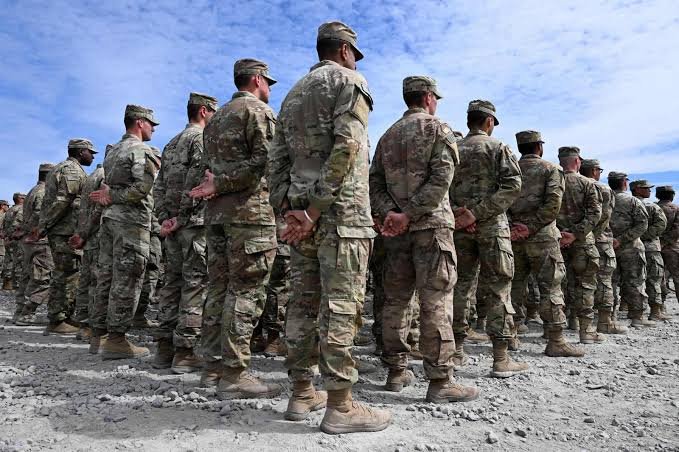
Their warning follows the recent arrival of US troops and weapons in Nigeria.
About 100 United States military personnel have arrived in what appears to be the first wave of the planned deployment of 200 troops. However, the Nigerian military has explained that the US troops will not be involved in combat operations but will help train Nigerian soldiers and gather intelligence.
The deployment comes after months of mounting pressure from President Donald Trump, who has strongly criticised Nigeria’s government for what he describes as its failure to adequately protect Christians from deadly attacks carried out by Islamist militants and armed groups.
Late last year, Mr Trump ordered airstrikes in Nigeria on Christmas Day, saying they targeted Islamic State terrorists in the North-west.
PREMIUM TIMES also earlier reported that the US Defense Department noted that, with American troops arriving at isolated sites lacking basic infrastructure, the troops will focus on establishing secure communications, building base facilities, and tightening operational security in coordination with Nigerian forces.
The group declared that any foreign troop deployment should comply with the Nigerian Constitution, which requires that a treaty be enacted into law by the National Assembly to take effect domestically.
“If there exists a mutual defence pact or expanded bilateral agreement permitting foreign troop deployment or the establishment of a foreign military base in Nigeria, such an arrangement must be laid before and enacted by the National Assembly. Anything short of this procedure raises constitutional red flags,” the group said.
The coalition stressed that Nigeria has the capacity to confront security challenges independently, given the country’s decades of experience in peacekeeping missions.
“Nigeria’s Armed Forces have a distinguished record in international peacekeeping under the United Nations and the African Union.
“Nigeria played a leading role in ECOMOG operations in Liberia and Sierra Leone. Our military institutions have decades of experience in counterinsurgency and regional stabilization.
READ ALSO: SPECIAL REPORT: Vulnerable Nigerian communities continue to suffer from US aid cuts
The group recommended that, rather than outsourcing security efforts, the government should modernise the armed forces, strengthen intelligence coordination, and improve troop welfare.
It also asked the government to invest in domestic defence production and to address the socio-economic drivers of insecurity.
”The Nigerian people deserve transparency. West Africa needs transparency and leadership at a critical time when many West African countries are seeking to liberate themselves from neo-colonialism, we cannot go in the opposite direction,” the group stated.