
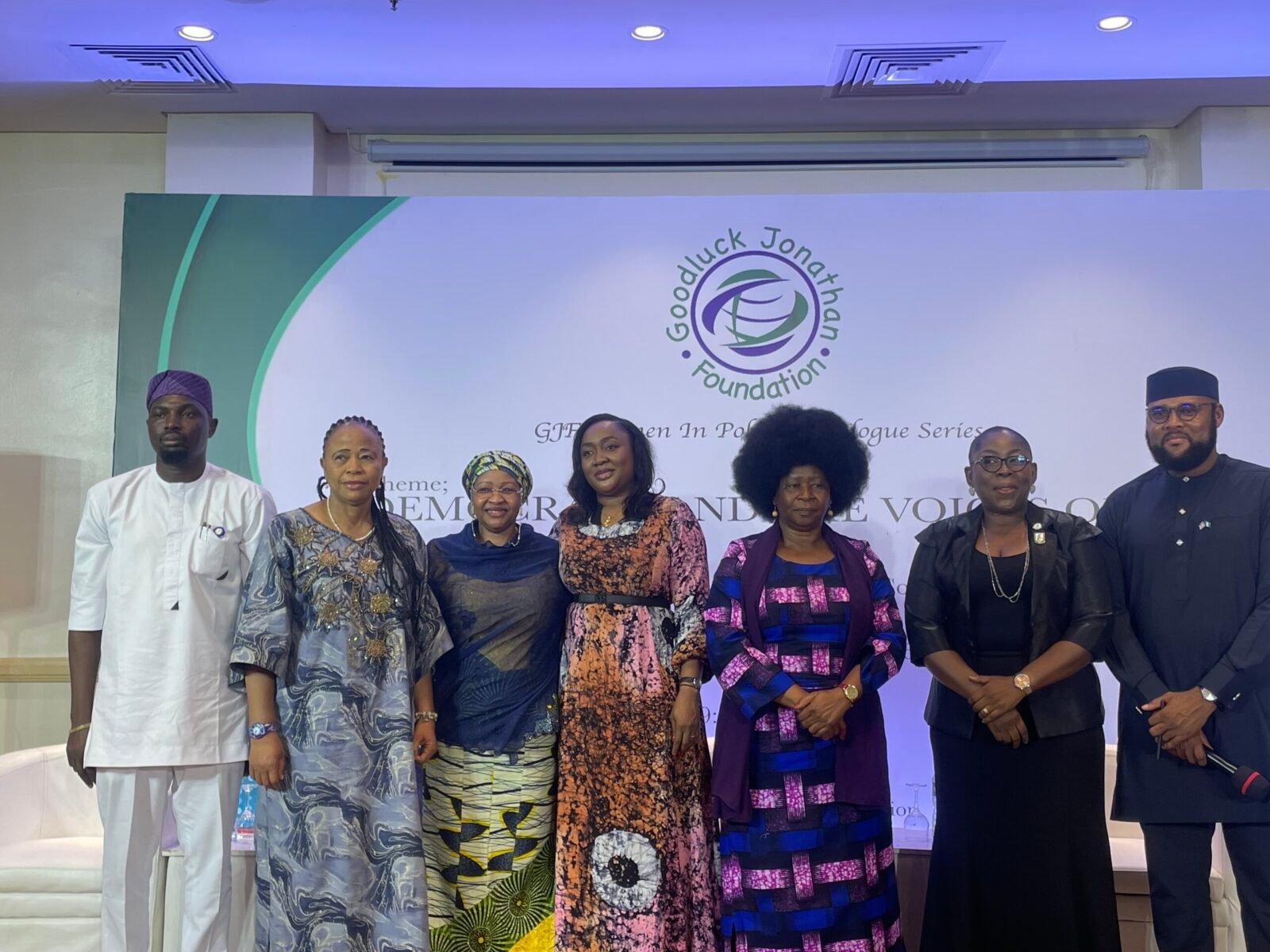
Participants at a policy dialogue have called for stronger measures to increase women’s participation in politics, warning that Nigeria’s democracy will remain incomplete if women continue to be marginalised in decision-making spaces.
The dialogue, themed “Democracy and the Voices of Women: From Voice to Power,” was organised by the Goodluck Jonathan Foundation to commemorate International Women’s Day 2026 in Abuja.
This year’s celebration, marked globally on 8 March, highlights the contributions of women and renews calls for gender equality.
It focused on the need to translate women’s participation in politics from symbolic representation into real political influence.
Speaking during a panel discussion, the National Chairperson of the Labour Party, Nenadi Usman, said women in Nigeria’s political system are often limited to ceremonial roles, particularly during election campaigns, rather than being allowed to participate meaningfully in decision-making.
Mrs Usman, a former minister of finance and one-time senator who represented Kaduna South, said women are frequently visible only during campaign periods when parties require them for mobilisation activities such as singing and dancing.

“The kind of voices that are being heard are usually during campaigns. That is when women are called upon to sing and dance or mobilise support. Often, the only visible woman among a group of men is the women leader,” she said.
According to her, women must be given more opportunities to represent themselves politically rather than having others speak on their behalf.
She argued that women already demonstrate leadership capacity within families and communities through the roles they play in raising children, managing households and mentoring younger generations.
“If women are trusted enough to raise children and shape their character, then we clearly have the capacity to lead. Mothers teach leadership in everyday life, responsibility, patience and discipline,” she said.
Mrs Usman also attributed the slow progress in women’s political representation partly to a lack of solidarity among women, noting that men often unite politically even across age differences.
“Men stick together. A man can relate easily with younger men politically. But many older women rarely mentor or work closely with younger women. We need to change that,” she said.
She recounted her experience during a previous senatorial primary election in which two male aspirants stepped down and mobilised their supporters for another male candidate when it appeared she might win the contest.
“That kind of alliance among women is rare. If women across different parties can sometimes unite to support one candidate, our voices will become stronger,” she added.
Mrs Usman further pledged that the Labour Party under her leadership would remove financial barriers for women seeking elective positions within the party.
“We want a situation where women who want to contest elections do not have to spend huge sums just to obtain party tickets. Women should simply register and contest if they are popular and have support,” she said.
She also highlighted the challenges women face in balancing political leadership with family responsibilities, noting that women often juggle public roles with domestic obligations.
Also speaking during the panel session, the spokesperson for the House of Representatives of Nigeria, Akin Rotimi (APC, Ekiti), represented by his legislative aide, Temidayo Taiwo-Sidiq, said the current House leadership has introduced measures aimed at improving gender inclusion within parliamentary structures.
Mr Taiwo-Sidiq said the House incorporated gender inclusion into its legislative priorities through a dedicated agenda within its legislative framework.
“When the House was inaugurated in June, it dedicated an entire legislative agenda, Agenda Six, to issues of inclusion. That shows from the outset that inclusion is a key priority,” he said.
According to him, the current assembly is the first to create two separate committees dedicated to women-related issues, the Committee on Women Affairs and Social Development and the Committee on Women in Parliament.
He noted that most female lawmakers in the House currently occupy leadership positions within committees.
“Out of the 17 women in the House, 15 of them are either committee chairpersons or deputy chairpersons. The two who are not yet in such roles joined through the August bye-elections and will likely be assigned positions once they settle in,” he said.
He added that the House is also considering several legislative proposals aimed at strengthening women’s political participation, including the proposed reserved seats for women in parliament.
Mr Taiwo-Sidiq also referenced a bill on independent candidacy sponsored by Mr Rotimi, explaining that the proposal would allow individuals to contest elections without relying on political parties.
“The importance of independent candidacy is that where political parties shut women out or internal party crises disrupt opportunities, a qualified woman can still contest elections based on her popularity and merit,” he said.
He disclosed that the bill has already passed second reading in the House and will be considered during the ongoing constitutional amendment process.
In her keynote address, human rights activist Ene Obi expressed concern over Nigeria’s poor record in women’s political representation, describing the country as ranking near the bottom globally in terms of female representation in governance.
ALSO READ: Nigerian govt to host Health Financing policy dialogue in September
Mrs Obi said that although women constitute nearly half of Nigeria’s population, their presence in political decision-making institutions remains extremely limited.
“Women make up about 49.3 per cent of the population, yet their representation in political institutions is very low. When decisions are made, the table is overwhelmingly male,” she said.
She traced the trend in female representation in the National Assembly since Nigeria’s return to democracy in 1999.
According to her, the Senate had only three female members out of 109 in 1999, while the number rose to nine in 2007 before declining again to four women in the current Senate.
In the House of Representatives, she said female representation has fluctuated over the years, with the highest number recorded in 2007 when 27 women were elected.
“In the current National Assembly, there are only 17 women out of 360 members in the House of Representatives. The numbers have been moving between three and five per cent, which is extremely low,” she said.
Mrs Obi argued that such limited representation affects the ability of women to influence policies, particularly on issues affecting women and girls.
She also stressed the need for greater mentorship for young girls and more training for female politicians to improve their visibility and communication in public and media engagements.
The activist commended the Speaker of the House, Abbas Tajudeen, and the Deputy Speaker, Benjamin Kalu, for supporting legislative efforts aimed at improving women’s representation, particularly the proposed reserved seats bill.
She noted that the gender equality legislation had struggled for years without progress but said the current efforts offer an opportunity to make significant change.
“They have to conclude what they have started by voting on the bill. Increasing women’s representation is essential for strengthening democracy,” she said.
Mrs Obi also urged participants to reflect on the roles women play within families and communities, arguing that societies depend heavily on women’s contributions despite their exclusion from political decision-making.
“Women organise communities, sustain families and support the informal economy. Yet when it comes to decision-making spaces such as the National Assembly or state assemblies, women are hardly present,” she said.
She added that improving women’s participation in governance would not only promote fairness but also strengthen democratic legitimacy in the country.