
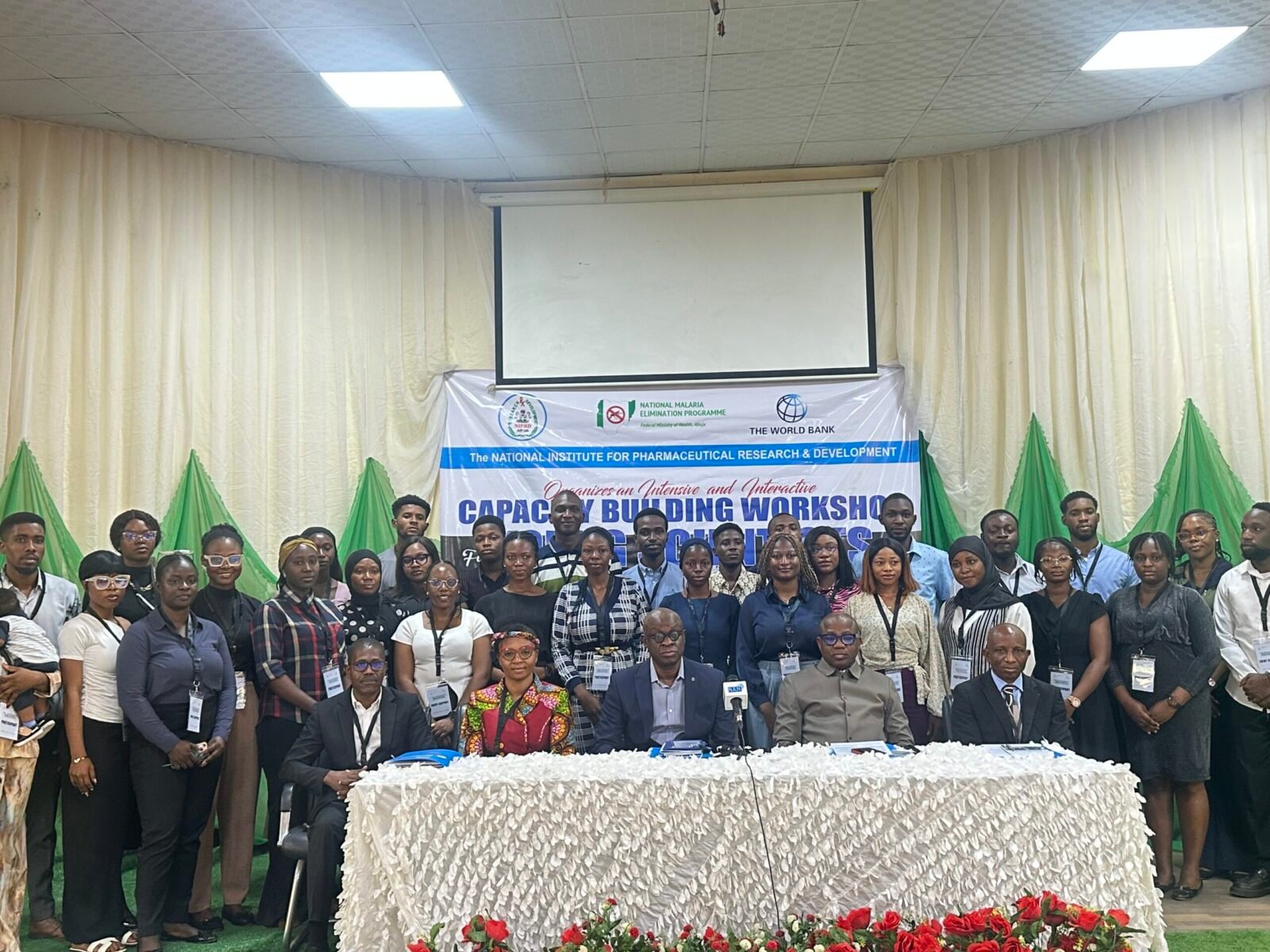
The National Institute for Pharmaceutical Research and Development (NIPRD) has trained 50 young scientists as part of efforts to strengthen Nigeria’s medicine security and improve the availability of safe, quality antimalarial drugs.
The capacity-building workshop, held under the World Bank-funded IMPACT Project in collaboration with the National Malaria Elimination Programme (NMEP), focused on research and development (R&D), regulatory compliance, quality assurance and sustainable drug development.
Organisers said the initiative was informed by lessons from the COVID-19 pandemic, which exposed Nigeria’s dependence on imported medicines and weaknesses in global supply chains.
Medicine security
Speaking at the workshop, the Director-General of NIPRD, Obi Adigwe, said medicine security must be treated as a component of national security.
Mr Adigwe, who was represented by Mboma Iheanyi, a director at the institute, recalled the disruptions experienced during COVID-19, when border closures and export restrictions made it difficult for countries to access essential medicines and vaccines.
According to him, the experience underscored the need for Nigeria to look inward and strengthen local pharmaceutical capacity.

“Security is not limited to insurgency. There is also medicine security,” he said, noting that in times of crisis, the country must be able to meet its own medical needs rather than depend heavily on external supplies.
Mr Adigwe added that exposing young scientists to responsible pharmaceutical development would also help curb ignorance-driven practices that contribute to the circulation of fake and substandard medicines.

Bridging academia and industry
The two-day workshop, the organisers noted, forms part of the Immunisation Plus and Malaria Progress by Accelerating Coverage and Transforming Services (IMPACT) Project (2025 Phase), with NIPRD serving as an implementing partner.
Mercy Aboh, technical assistant (Pharma and Industry) to the Director-General of NIPRD and lead for the IMPACT Project at the institute, said the programme seeks to address the long-standing disconnect between academic research and pharmaceutical manufacturing.
Ms Aboh explained that despite advances in science and technology, translating research findings into market-ready pharmaceutical products remains a major challenge.
Engagements with industry stakeholders, she noted, revealed gaps in the development of complex formulations and dosage forms, partly due to limited practical exposure for young professionals.
Ms Aboh said the training is designed to equip early-career scientists in pharmacy and related fields with the skills required to drive medicine security and support the production of medicines that meet global standards, including World Health Organisation (WHO) prequalification benchmarks.
“We must train early-career scientists in pharmacy and other health-related fields so they can champion medicine security and ensure that medicines produced in Nigeria meet global standards,”she noted.
Beyond production
Ms Aboh highlighted challenges such as poor storage conditions, transportation issues, high temperatures, and power outages, which can compromise drug potency in tropical climates.
According to her, the training covers drug transportation, storage standards, and regulatory compliance to ensure medicines remain safe and effective throughout the supply chain.
READ ALSO: Minister blames poor maintenance culture for hospital equipment failures
Nigeria continues to grapple with the circulation of fake and substandard medicines, a problem regulators have repeatedly flagged as a public health threat.
Ms Aboh said strengthening local capacity and improving technical knowledge among young scientists would help tackle the problem sustainably.
Practical impact
Uzuh Nwakaego, a member of NIPRD’s research team who is pursuing further studies in public health, said the programme encourages young scientists to translate laboratory research into solutions that benefit patients.
Ms Nwakaego described it as an opportunity to move science “from the bench to the bedside” and ensure that innovation goes beyond publications.
Similarly, Folashade Alabi, a pharmacist and support staffer at NIPRD, said the training aligns with her interest in sustainable drug discovery and development.
Ms Alabi noted that building stronger research and regulatory systems would not only improve medicine safety locally but also position Nigeria more competitively in international pharmaceutical markets.