
Salamatu Salihu holds her face in her palms, weeping. Her next words were a quiet and desperate plea for forgiveness.
“I want everyone to forgive him,” said the 70-year-old mother whose son, Idris, had been unmasked as a terrorist collaborator. The last time Mrs Salamatu saw him was early last year, when soldiers stormed their Kemanji village and arrested civilians alleged to have collaborated with Ansaru terrorists, locally known as the Mamuda group.
Since that incident, Mrs Salihu, a widow, has lived under a cloud of suspicion. Villagers were reluctant to lead this reporter to her home. The only person who agreed to help did so cautiously, offering only vague verbal directions, rather than personally guiding the way.

The hesitation was palpable. Conversations slowed down when her name was mentioned. Some residents either avoided eye contact or walked away; others said they did not want to be seen taking sides. In a community where allegations of collaborating with terrorists can invite hostility either by the military or the insurgents, even a simple act of pointing the way is risky.
By the time PREMIUM TIMES located her compound on the edge of the village, the isolation surrounding her was visible. Neighbours kept their distance, and children watched from afar. Whatever the truth about her son, Mrs Salihu now lives in social exile, a “punishment” she described as “a test from Allah.”
This suspicion did not just come from nowhere. It is rooted in the aftermath of the terrorists’ takeover of the nearby forest reserve, creating new economic alliances. As poverty bit harder and insecurity deepened, the line between survival and complicity blurred for many families living at the edge of the national park.

To understand why a mother now sits alone in the village she has lived all her life, one must look beyond her compound—into the dangerous forest where timber, money and guns reshaped both the landscape and the loyalties of locals who depended on it for survival.
Before becoming a park ranger, Idris, popularly known as Idi Gurgu, was a farmer and hunter who knew the forest reserve inside out, according to his mother and other villagers.
“People are saying that Idi is a terrorist, but that is not true,” Mrs Salihu told PREMIUM TIMES, her eyes locked with our reporter’s. “You need to know how the villagers pushed him into that.”
Because of its dense vegetation and limited state presence, the poorly governed 5,340.82-square-kilometre Kainji forest reserve gradually became a hideout for jihadists and bandit groups, many of whom specialise in kidnapping for ransom. The jihadists established a stronghold in the forest around 2019, steadily spreading their extreme ideology in surrounding communities in Niger and Kwara states. Their relationship with locals remained cordial until early 2025, when they turned hostile, accusing them of aiding a military operation that targeted their enclaves.
Before that rupture, the group exploited the Nigerian state’s inability to adequately protect rural settlements. A review of propaganda audio messages, corroborated by interviews with residents, indicates that the jihadists portrayed themselves as alternative security providers, confronting rival bandits and, in some cases, facilitating the release of kidnapped persons.
This opportunistic intervention helps explain Idris’ emergence as an ally of the terrorists. According to his mother and several residents, including a local chief and a vigilante commander, community leaders approached him at the height of insecurity, urging him to seek the jihadists’ assistance in confronting bandit groups who were brazenly kidnapping locals.
In an audio message delivered in Hausa and his Bokobaru local dialect, Idris recounted how he established his relationship with the Mamuda group, a connection many people in Kemanji now whisper about.
Idris said many people now call him a member of the Mamuda group. “Yes, it is true,” he admitted in the audio, which featured jihadi-themed background chants.
The story, he said, began after kidnappers demanded N30 million as ransom for seven people abducted from Kemanji and neighbouring villages.
“They called me and asked for a way forward,” he said in the audio, recalling the meeting with the village leaders. “They wanted me to lead a team of vigilantes and a few others who know the forest very well to Mallam Mamuda’s place.”
“They demanded N30 million ransom,” he said. “But we went there with Mallam Mamuda’s boys, rescued the victims, and killed the kidnappers — there were 12 of them.”
Afterwards, the jihadists made him an offer he could not refuse.
“Mallam Mamuda requested that, since I understand every part of the forest, I should join his team to help rescue kidnapped victims and continue working with them subsequently,” Idris recalled. “I complied.”
For Idris, what began as a mission to “help Kemanji people” gradually pulled him deeper into the forest and into a network whose atrocities have now disrupted peace and local economies beyond his village. His story is that of duty, survival and complicity.
His septuagenarian mother maintained that Idris was not a terrorist, even as she pleaded for forgiveness on his behalf.
A dangerous pattern
From the thick Sambisa forest, long dominated by Boko Haram and its breakaway faction, the Islamic State West Africa Province (ISWAP), to Alawa Forest Reserve in Niger State, Nigeria’s forests have steadily evolved into reservoirs of terror. Across these enclaves, armed groups appear to use a common playbook: embed within difficult terrain, impose control, and lure local populations into their ranks.
In Sokoto and Kebbi states, the Lakurawa terror group had taken root in remote communities, blending jihadi ideologies with territorial influence amid governance failure. Security sources have also linked the Sadiku-led Boko Haram faction to recruitment drives that pressure rural youths into auxiliary roles. Also, criminal bandit groups operating across Zamfara, Kaduna, Katsina and other northern states have been accused of recruiting residents as informants, food suppliers, or foot soldiers, often by threat of violence.
The military continues to launch offensives to dislodge the terrorists from these forests. Many of these operations involve aerial bombardments, ground raids, and clearance sweeps across known enclaves. In several instances, camps were overrun and fighters killed, but the vast terrain and porous borders often allowed remnants to retreat deeper into adjoining reserves or disperse into rural settlements.
In early 2025, security authorities issued fresh directives for terror elements to be completely uprooted from the Kainji forest corridors. The operations signalled renewed urgency as the conservation haven had slipped into the control of terrorists too sophisticated to ignore.
Long before that order, Kainji forest had already been stripped of much of its rich vegetation amid a tricky system in which terrorists imposed levies on desperate loggers who operated in the forest following the suspension of park services within.
Through on-the-ground reporting and satellite imagery analysis, using Google Earth Pro, PREMIUM TIMES found that a massive act of deforestation occurred within Kainji National Park between late 2021 and early 2025. Locals, including insiders and residential park rangers, alleged that the forest depletion occurred under a system in which terrorists imposed levies on loggers who depended on the forest for their livelihood.
Into the terror-driven logging
Logging around Kainji had been going on before the terrorists infiltrated the forest reserve. It only became a criminal enterprise three years after their arrival, park rangers and local authorities said.
“Before the Mamuda group came, nobody cut trees without forestry permits from the park,” a former ranger, Ba Sani, told this reporter in his Kemanji village. “And the national park has never given anyone the clearance to cut trees inside the reserve.”
But everything changed in 2021, Mr Sani said, recalling how terrorists, in the late hours of 7th March 2021, ambushed a patrolling team of rangers in the Kemanji-Oli camp axis of the forest reserve and killed a man named Alhassan Tanko.

That same year, in October, the National Park Service suspended operations in the reserve due to growing insecurity. Even amid the breakdown of oversight, the national park later intercepted six trucks loaded with timber.
With the park left unguarded for long, illegal loggers moved in. Their activities, however, soon brought them into conflict with the terrorists, who had already spread across large parts of the forest. After initial clashes, the two sides struck a deal granting the loggers access to the forest in exchange for paying fees to the armed group.

The Kainji National Park did not respond to requests for comment on the scale of illegal logging in the reserve and its efforts to curb it. Mohammed Nuhu, the park’s spokesperson, said all enquiries should be directed to the National Park Service. The service had not responded to an FOI request sent by this newspaper.
In a propaganda audio clip, the leader of the terror group, Mamuda, boasted about giving “unhindered” access to the forest reserve for logging and other biodiversity-threatening activities—a type of access he said “yan gandu (park rangers)” had always prohibited. Idris corroborated this in his audio message and warned locals that a fight against the terror group would be a futile endeavour.
Logging and other related activities are prohibited under the National Park Service Act and relevant state forestry laws, except where expressly permitted by park authorities. But for about five years, it has thrived inside the Kainji forest reserve.
However, strict rules applied, explained a former insider in a village near the Nigerian border with the Benin Republic. Now posing as an undercover agent, he said he had worked with the loggers “just to understand the business and gather information.”
“No more than five people—two chainsaw operators, a bush manager, and three of his boys—were allowed per operation,” said the former insider, who pleaded anonymity because he currently works with vigilantes and security forces to fight against the armed group.
Many residents across communities bordering the forest say the arrangement between the terrorists and some local collaborators became a source of funding for the group’s operations. Several locals, who spoke on condition of anonymity for security reasons, alleged that money collected from loggers and other individuals seeking access to the forest was used by the insurgents to sustain their operations.
“That collaboration financed the terrorists’ activities,” one resident said, echoing a widely held belief in the area. Mr Sani, the park ranger who has worked in the area for years, shares this view. He recalled that when the terrorists first appeared in 2019, they were poorly equipped and had limited resources. Others described it as a structured system of levies imposed on those who depended on the forest for their livelihoods, a situation that effectively evolved into what experts now describe as an informal financing network.
Taiwo Adebayo, a Lake Chad Basin researcher with the Institute for Security Studies (ISS), emphasised that people in local communities may act out of desperation when the state is unable to provide protection.
Mr Adebayo described the situation in Kainji forest as the intersection of licit and illicit economy in conflict. In this system, he said legitimate economic activities—such as licensed logging—operate in the same space where illicit actors have gained ground.
“Even those with proper licenses can find themselves working in environments where the state has limited presence or control,” Mr Adebayo said. “In those gaps, lawful business activities can intersect with criminal or armed groups.”
Stressing that this intersection should not automatically be labelled collaboration, the researcher acknowledged that such overlap can unintentionally contribute to “the financing, resilience and sustenance” of armed groups.
For him, the real policy challenge lies with the state. Authorities must block financing channels without shutting down legitimate economic activities or undermining community economic rights, he advised. He noted that measures, such as blanket bans without full territorial control, could backfire.
“People would still find ways to continue working, potentially creating resentment and opening up recruitment and intelligence opportunities for armed groups,” he said.
“Counterterrorism and counterterrorism financing operations must be organised in a way that protects communities and their economic rights, their livelihood.”
Data from Global Forest Watch showed an unprecedented loss of tree cover, with 2,017 deforestation alerts in Kainji between 2021 and early 2025. Satellite analysis conducted by this reporter also showed vast areas of forest cleared within the same period.


The former insider who refused to meet our reporter in person estimated that the terrorists collected more than N500 million in structured taxes imposed on loggers alone, a figure PREMIUM TIMES could not independently verify. According to him, the weekly tax income ranged from N700,000 to N1.5 million.
“I can’t say about what they got from taxes imposed on fishermen, farmers or hunters, but I knew that they amassed between N700,000 and N1.5 million from loggers per week,” he said.
The former insider explained that logging crews were issued signed passes stating their entry and exit dates. Overstaying could mean seizure and destruction of equipment, or kidnapping, even death, he added.
At the peak of the trade, he said dealers came from across Nigeria and the neighbouring Benin Republic. They worked through “bush managers,” often former poachers familiar with hidden routes. These intermediaries liaised with a commander identified by multiple sources as Aiman. Access depended on proximity to militant camps: areas too close were denied; distant zones were approved.
Some residents initially resisted the large-scale logging, warning that the community could not withstand the environmental and security consequences.
Ahmed Usman, a resident and former chairperson of the Kaiama Development Association (KDA), recalled how his association confronted loggers and reported the matter to authorities.
“We held meetings with the officials of the National Park here in Kaiama, and they told us they were doing their best,” Mr Usman said. “We wrote letters to the Federal Ministry of Environment and copied the National Park Service, including security agencies.”
But Mr Usman gave up the fight after he was assaulted twice by those he described as “hired thugs” collecting tolls from timber-laden trucks.
The quiet arrest
The first visible disruption of the network came far from the forest.
It was on a Friday in March 2025 when soldiers quietly walked into a congregation observing Juma’at service in Kemanji and arrested Suleiman Salihu in his white mosque security outfit.
“The arrest was calm, almost unnoticed,” Umar Mohammed, the head of the local vigilante in the village, told PREMIUM TIMES.
Mr Salihu was a hunter and a farmer before he ventured into the logging business, his wife, Salamah, told PREMIUM TIMES in their home in Unguwar Zabarmawa in Kemanji. His logging endeavour was a rough one, his eldest son Jaafar interjected, recounting when one Ba Gado, alongside another person, “met him at our farm” around 2023.
“We were together with him on the farm the day when they came,” Jaafar recalled. “They stepped aside and had a conversation, and my father immediately left the farm for the forest reserve.”

Mr Salihu would not return from that trip for four days. Terrorists had kidnapped him and three other people he went to the forest with. They would not be released until a ransom of N400,000 was paid, said Jaafar.
“At the time, we didn’t know he was in partnership with Ba Gado,” Jaafar said, adding that the ransom was raised by the family alone.
While many people wondered why Mr Salihu was arrested, the message was clear to his allies, including Idris and five other persons who fled the village. While the destination of others remains unknown, many villagers believe Idris is in the forest with the terrorists.
Subsequent arrests were made after security forces interrogated Mr Salihu in Ilorin, Kwara State, according to intelligence sources and community leaders. Among those arrested were sawmill owners, including Ba Gado, believed to be Mr Salihu’s partner.
Muhammed Zikki, the village head of Kemanji, said the arrests were based on local intelligence.
“I don’t know if they are terrorists or terror collaborators,” Mr Zikki said. “What I know is that they were intermediaries.”
Soldiers later brought Mr Salihu to Kemanji to lead them to the terrorists’ enclave. The aftermath of that operation was more violent attacks. Mr Zikki said the terrorists believed the villagers had invited the soldiers and began targeting them in reprisal attacks.
The campaign of terror
Between 2021 and early 2025, the Mamuda group launched deadly attacks on communities in Kwara and Niger states, and parts of northern Benin.
Last year, the group carried out several violent attacks on villages like Karonji (also known as Duruma), killing locals and destroying properties. In Dekera, a village in Niger State, the group killed the village head after accusing him of colluding with security forces.
Locals monitoring their movements told our reporter that the group was also responsible for several attacks in the northern Benin Republic, including the raid on Kalalé on 10 September 2025 and the 27 July 2025 attack on a church in a town near Kalalé, kidnapping six worshippers, including a member of the local Catholic community.
“The group demanded 10,000,000 CFA as ransom for the Christians abducted in Benin,” a local source in Karonji, a Kwara village less than a kilometre from Benin, said.
In a coordinated counter-terrorism operation in mid-2025, Nigeria’s security forces captured two leaders of the group and linked them to Ansaru, otherwise known as Jama’atu Ansarul Muslimina fi-Biladis Sudan, an al-Qaeda affiliate.
The terror leaders— Mahmud Usman (Abu Bara’a) and his deputy, Mahmud al-Nigeri, also called Mallam Mamuda—were arrested following months of intelligence gathering and surveillance operations that were hailed by officials as a major breakthrough in dismantling their network.
The two men had been on Nigeria’s most-wanted list for years and were accused of coordinating sleeper cells, financing terrorist activities, recruiting fighters, and orchestrating violent attacks, according to the National Security Adviser, Nuhu Ribadu.
They face a 32-count terrorism charge, including those related to terrorism, financing it through kidnapping and robbery, and plotting violent operations across several states.
In September 2025, Mr Usman was convicted and sentenced to 15 years in prison after pleading guilty to illegal mining charges that allegedly funded arms purchases and other terror operations. His deputy pleaded not guilty to all the charges.
Authorities linked the group to several high-profile attacks, such as the July 2022 Kuje prison break in Abuja that freed scores of terrorists. They were also tied to decades-long kidnappings and armed robberies used to fund their activities.
While illegal logging formed part of the group’s economic ecosystem, it has not featured among the formal terrorism charges brought against the Ansaru leaders.
Tracing the logs
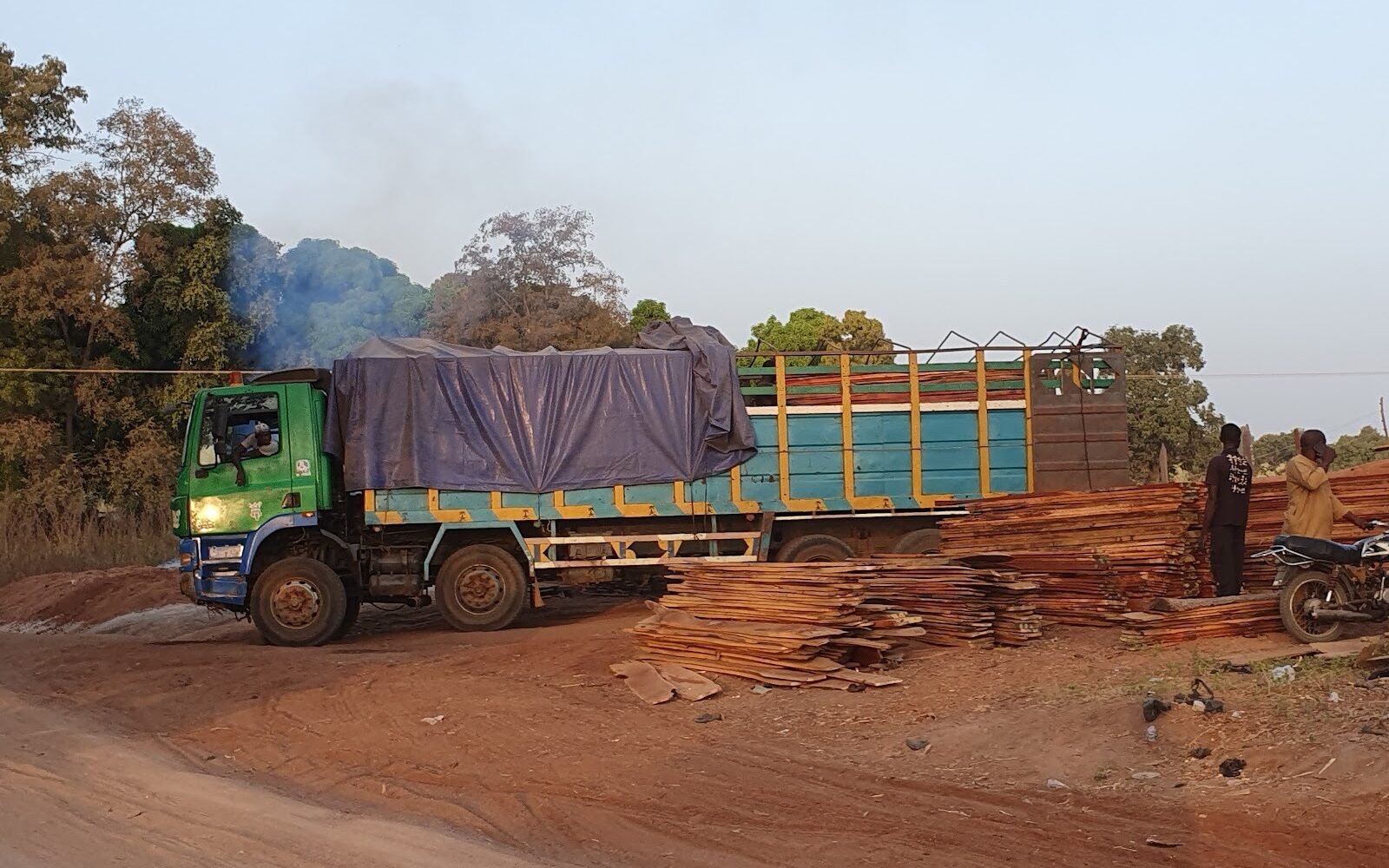
One of the final stages of a supply chain that begins deep inside the forest is freshly sawn logs, scattered around sawmills in the heart of Kaiama town.
“Those were woods from the national park,” said a member of a Local Advisory Committee (LAC) for Kainji National Park, Yakubu Musa, darting his eyes toward the timbers strewn across four large sawmills. Near these sawmills, empty timber trucks sat idling in the dust. The trucks, he said, are no longer as busy as they used to be.

The sawmills operate in close proximity, with the rasp of blades tearing through the air as workers cut and shape the trees into planks. The trees, mostly sourced from a protected forest, were being brazenly processed in the open.
By the time the logs arrive in Kaiama, their violent journey has already been laundered. The sawmills get busy as long trucks wait to transport the sawn logs.

“The woods usually get transported down to Lagos or Cotonou (Benin) from where they would be shipped overseas,” Mr Musa, the LAC member, said. Many locals corroborated him.
Data from the website of the Nigeria Bureau of Statistics (NBS) showed that Nigeria typically records large exports of wood.
In the first quarter of 2025 alone, the country exported wood valued at N65.85 billion. Analysis of the data shows that countries in the fold of the Economic Community of West African States (ECOWAS) accounted for 14.15 billion of the total exports.
Further review shows that the majority of the wood was exported to neighbouring countries such as Benin and Togo. While Benin was identified as the top destination for Nigeria’s wood exports, receiving N29.83 billion worth of the product, Togo followed with N19.32 billion in imports.
Asian and European countries accounted for the rest, with the latter importing products worth N102.21 million, while the former imported products valued at N94.80 million.