
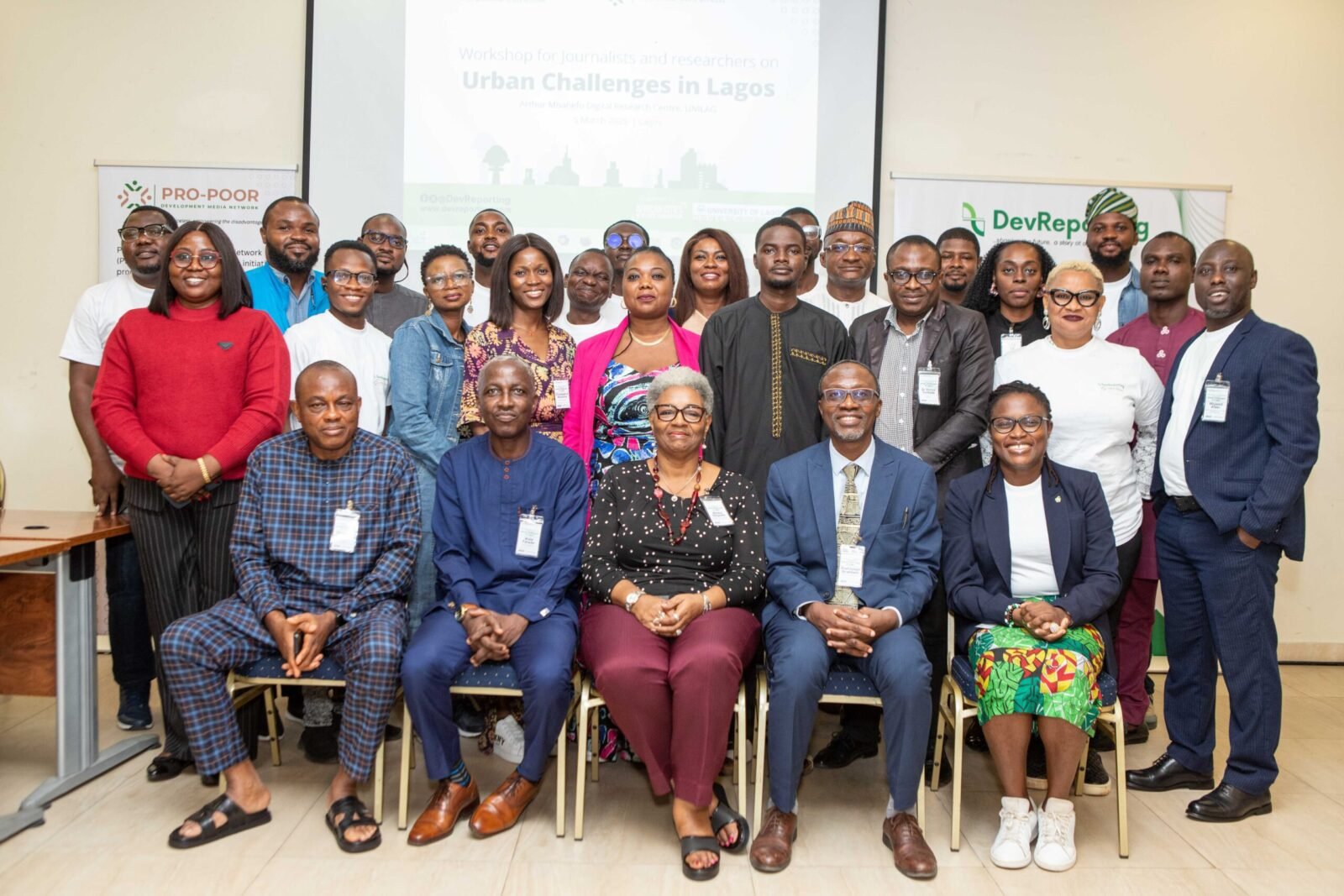
Experts have called for stronger collaboration between journalists and researchers to improve reporting on urban challenges and support inclusive development in Lagos.
The call was made at a capacity-building workshop organised by DevReporting, which brought together journalists and researchers to strengthen development reporting and close the longstanding gap between the two professions.
The workshop, held on 5 March at the Arthur Mbanefo Digital Research Centre of the University of Lagos, is part of an urban reporting project supported by the African Cities Research Consortium (ACRC).
ACRC is a research network studying how African cities function and how governance systems shape development outcomes.
Bridging the journalist–researcher gap
Speaking at the workshop, DevReporting Team Lead, Mojeed Alabi, said the relationship between journalists and researchers has often been strained, limiting the impact of development research and public-interest journalism.
Mr Alabi said both groups sometimes view each other as ego-driven, creating a disconnect that denies journalists access to credible research evidence and limits the wider public platform that journalism provides for researchers.

He recalled a similar engagement held in Tanzania in 2023, where stakeholders raised concerns about the divide between the two professions.
 “The currency spent on action research for development journalism is collaboration, and that is what has made this initiative possible,” he said.
According to him, action research can yield meaningful development outcomes only when journalists and researchers work together.
Media partnership for inclusive city development
The Director of Uptake at ACRC, Ismail Ibraheem, a professor, said ACRC works across African cities to understand how urban systems operate and how they influence development outcomes.
Mr Ibraheem explained that ACRC research examines the interconnected systems that determine how cities function.
“We cannot understand how the city works without understanding its configuration in terms of government, transportation, education, health and other sectors,” he said.
According to him, research across cities, including Lagos, shows that successful urban development often depends on elite commitment, reform coalitions, organised communities and strong state institutions.
He added that the media plays an important role in promoting accountability and ensuring that research findings translate into public action.
In a goodwill message delivered virtually, Chris Jordan, ACRC communications and impact manager, urged journalists to focus on human-centred reporting that highlights the realities of marginalised communities.
Mr Jordan said journalists have unique access to communities and can translate research insights into compelling narratives that reach the public more effectively than academic publications.
“You can access insights from people and give engaging stories to the public and communities. We look forward to seeing what you journalists produce on this project,” he said.
Gaps in urban services
During the workshop, Taibat Lawanson, a professor and Leverhulme Professor of Planning and Heritage at the University of Liverpool, presented findings from the foundation phase of the ACRC research project, which began in 2022.
Mrs Lawanson said the study examined nine major systems that shape how cities function, including water supply, sanitation, transportation, health, education, energy, food distribution, finance and digital connectivity.
She said the research identified significant gaps in access to essential services, particularly among residents of informal settlements.
READ ALSO: EFCC returns stolen N279m to Wole Soyinka centre for culture in Lagos
According to her, proximity to formal systems often determines whether residents can access basic services.
She added that although the Lagos State Government provides about 40 per cent of the state’s daily water supply capacity, only about 30 per cent of residents currently have access to public water systems.
Water, sanitation challenges
Researchers also presented findings from community-based projects focusing on water, sanitation and waste management in Lagos.
Oluwaseun Muraina, co-lead of the ACRC Water, Sanitation and Hygiene (WASH) project, said the initiative focuses on improving access to water and sanitation in Okerube, a large informal settlement in Alimosho Local Government Area.
Ms Muraina said the project adopts a community- and gender-led approach, placing women at the centre of governance and decision-making on water and sanitation infrastructure.
According to her, women-led water committees have secured the local ward councillor’s commitment, resulting in the transfer of two boreholes to the committees for management.
However, she noted that the absence of structured management provisions raises concerns about the initiative’s long-term sustainability.