
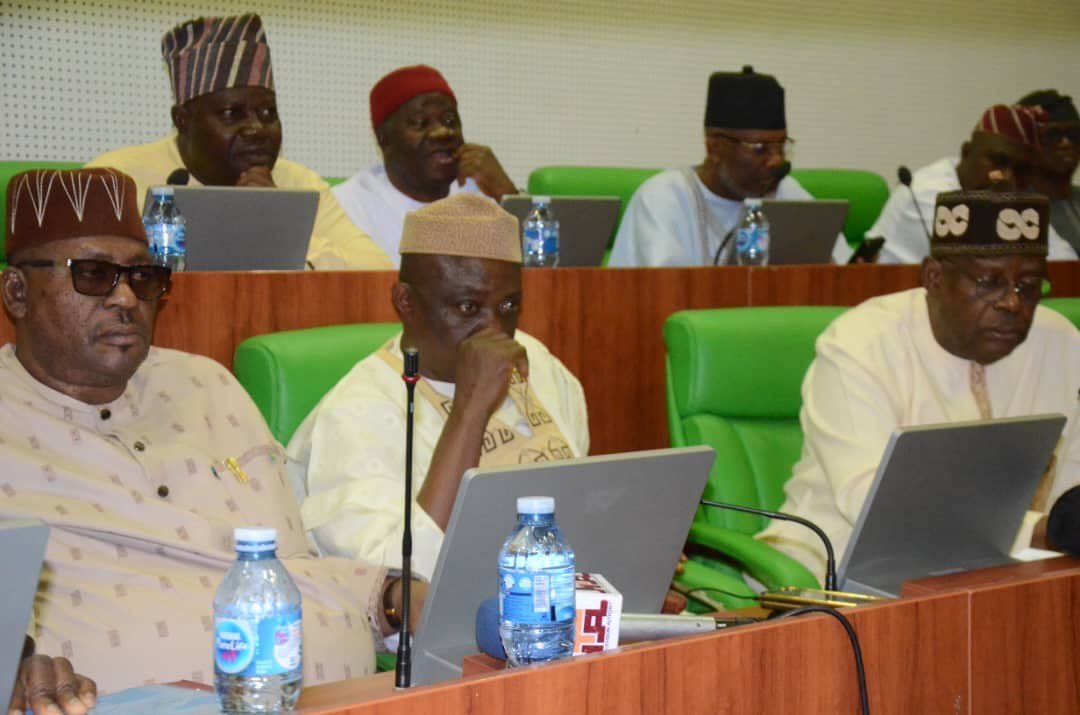
There was drama on Tuesday at the House of Representatives as lawmakers clashed with the Acting Managing Director of Nigerian Bulk Electricity Trading PLC (NBET), Akinnawo Johnson, during an oversight session on the government’s revenue performance.
The session, convened by the House Committee on Finance, chaired by James Faleke (APC, Lagos), was part of ongoing engagements with key revenue-generating agencies to examine their performance and the implementation of fiscal policies critical to government income.
Trouble began when Mr Johnson, in his opening remarks, stated that NBET was “ipso facto not a revenue-generating entity.”
According to him, the agency is funded through regulatory income derived from the market-administrative charge embedded in electricity tariffs, not from profit-making activities.
“NBET is ipso facto not a revenue-generating entity but an entity provided funding for its operation from the market administrative charge that is earned as a portion of the electricity tariff,” he said.
He explained that under the Multi-Year Tariff Order issued by the regulator, distribution companies receive two invoices monthly, one from NBET covering energy and capacity charges, and another from the Nigerian Independent System Operator (NISO).

Mr Johnson said funds received by NBET for energy and capacity are paid 100 per cent to generation companies without margin.
“We trade at no margin,” he said, adding that NBET only retains a share of the tariff classified as regulatory income to cover its recurring expenditure, while its capital projects are funded through appropriation by the National Assembly.
But Mr Faleke faulted the characterisation, insisting that any inflow to a government entity amounts to revenue and must be treated as such.
“What is the meaning of earning? Is it an inflow or an outflow?” the chair asked.
When Mr Johnson responded that earning implies inflow, Mr Faleke interjected: “When you come to the Committee on Finance and tell us your agency is not revenue-generating, that is not correct. You generate revenue. The application of that revenue is another matter entirely.
“Whatever revenue you generate, you cannot spend it until it is appropriated by the National Assembly. Even if you sold scrap, it is income to the government.”
He stressed that the committee was aware of the distinctions between agencies like the Nigerian National Petroleum Company Limited (NNPCL) and others, but maintained that all revenues, regardless of volume or structure, must be disclosed and accounted for.
Tension heightened when Stanley Olajide (PDP, Oyo) accused the NBET boss of interrupting the chair and breaching parliamentary procedure.
“We owe you a duty of care. There are procedures here. Floor must be yielded to you before you speak,” Mr Olajide cautioned.
He subsequently moved a motion to step down NBET’s appearance, citing illegible submissions and the presentation of only five copies of documents to a committee with over 70 members.
Although Mr Faleke initially said the committee needed to “educate” the NBET chief, the matter escalated further when lawmakers questioned the agency’s claim of partial self-funding.
Mr Johnson maintained that NBET is funded for recurrent expenditure from regulatory income and for capital projects through appropriation.
He added that the agency had complied with operating surplus remittances and that deductions had been made from its income in the past.
He disclosed that deductions were made from NBET’s share of regulatory income and, at times, from funds meant for generation companies, though such deductions were later reversed following clarifications.
According to him, the Minister of Finance granted an exemption in December 2025, invoking powers under the Fiscal Responsibility Act.
However, the committee pressed further. “If deductions are from your income, why did you say you are not a revenue generator?” Mr Faleke queried.
Lawmakers insisted that all income earned by any agency of government is backed by law and subject to legislative oversight.
Munachim Alozie (LP, Abia) openly rebuked the NBET boss, accusing him of arrogance and questioning his understanding of accountability to parliament.
“You were appointed by the government. Who are you answerable to? You came before the House of Representatives to lecture us that you are not a revenue-generating agency,” he said, warning that the committee could walk him out.
The hearing took another turn when lawmakers examined documents from the Corporate Affairs Commission on NBET’s incorporation and ownership structure.
Mr Johnson told the committee that NBET’s ownership comprises the Bureau of Public Enterprises and the Ministry of Finance Incorporated. He explained that the company’s structure was designed in line with the Presidential Debt Recovery Committee’s approval to make it a special-purpose vehicle that is “bankruptcy remote.”
However, lawmakers raised concerns over the use of private individuals as shareholders in a company owned and funded by the federal government.
“On what ground do you enlist individuals as shareholders for a company owned by the federal government? Is that directive superior to law?” members asked.
READ ALSO: Forgery: Lawyer blasts Nigerian govt for failing to prosecute ex-minister Uche Nnaji
Mr Johnson said the structure was advised by the Ministry of Finance and backed by the mandate of the Presidential Debt Recovery Committee.
But lawmakers insisted that extant laws, not administrative directives, must guide all actions of government agencies.
As tempers flared and members repeatedly asked him to answer questions directly, Mr Olajide renewed his motion to step down NBET’s appearance.
The committee adopted the motion, suspending further consideration of NBET’s submission to a later date.
Before adjourning the matter, Mr Faleke directed NBET to return with additional documents, including the letter from the Presidential Debt Recovery Committee authorising the company’s registration structure and the identities of the shareholders of NBET Finance Company Plc.
The committee also summoned the Corporate Affairs Commission, the Director of Debt Recovery and the Minister of Finance to appear alongside NBET next Tuesday at 12 p.m. to explain the rationale for listing individuals as shareholders in a government-owned entity and to clarify issues relating to debt exposure and accountability.