
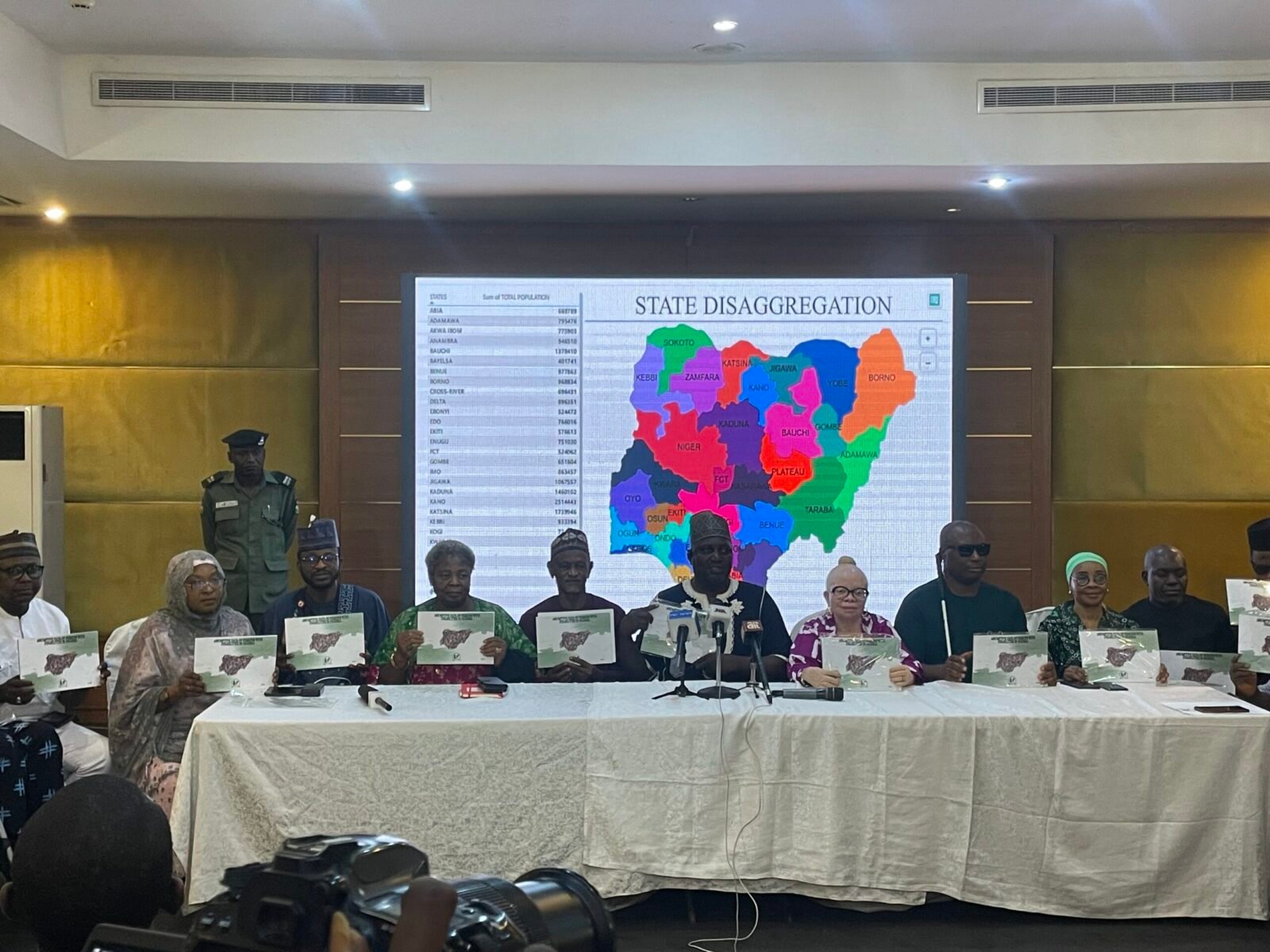
Stakeholders have emphasised the urgent need for evidence-based policymaking for persons with disabilities (PWDs) in Nigeria, following the unveiling of a landmark exploratory database by the Joint National Association of Persons with Disabilities (JONAPWD) on Wednesday.
They highlighted how, for decades, the disability community in Nigeria has struggled with the absence of reliable demographic data, a gap that has hindered planning, advocacy, and effective interventions.
Speaking at the event, the Senior Special Assistant to the President on Special Needs and Equal Opportunities, Abba Isa, described the publication as “a significant milestone in advancing inclusive development and evidence-based policy making for PWDs across Nigeria.”
According to him, policymakers and development partners have relied on rough estimates of the PWD population for several years, ranging from 25 million to 40 million.
These figures, he said, were often based on fragmented information, and were insufficient for designing effective programmes.
The database projects that Nigeria had approximately 35 million PWDs in 2025, with Kano State recording the highest number at around 2.5 million, followed by Lagos State with 2.1 million.

The report disaggregates PWDs by disability type, gender, and state, offering unprecedented clarity.
According to the data, the Physical Disability cluster constitutes the largest group at about 8.2 million persons, followed by the Deaf community at 7.7 million. Male PWDs are estimated at 17.6 million, while female PWDs number about 17.2 million.
Mr Isa stressed that such detailed data allows governments, civil society organisations, international partners, and researchers to design targeted programmes that respond to the specific needs of different disability clusters and demographic groups.
“This level of detail is not only commendable but also transformative. For the first time, stakeholders and development partners have access to a structured and disaggregated dataset that can guide targeted interventions,” he said.
The National President of JONAPWD, Abdullahi Usman, explained that the report, titled, “Assumptive Demographic Data on Persons with Disabilities in Nigeria,” represents a deliberate effort to bridge long-standing gaps in planning and policymaking.
“Globally, a working assumption places persons with disabilities at approximately 15% of every national population.
“In Nigeria, applying this global benchmark to the 2025 projections of the National Population Commission gives us a clearer, though still evolving, picture of the magnitude of our community across the 36 states and the Federal Capital Territory,” Mr Usman said.
He acknowledged the report’s limitations, particularly regarding children and youth with disabilities, pointing to weak detection systems and insufficient disability-sensitive administrative structures.
Gender considerations also featured prominently in the discussion. Mr Usman highlighted that women with disabilities face layered marginalisation, including restricted access to education, economic exclusion, gender-based violence, and cultural silencing.
“Addressing disability without addressing gender is therefore insufficient; both must be integrated into every planning and policy framework,” he said.
Adeyi Daniel, secretary of the National Population Commission (NPC), lauded JONAPWD’s initiative, noting that the country has not conducted a comprehensive national census since 2006.
READ ALSO: SPECIAL REPORT: Persons with disabilities suffer exclusion from healthcare in Kano communities
“This publication brings forward verifiable data that will greatly enhance governance, policy formulation, and planning for PWDs,” Mr Daniel said, pledging the Commission’s continued support.
Mr Isa concluded that the federal government, under the Renewed Hope Agenda, remains committed to supporting initiatives that generate credible evidence for inclusive development.
The publication, according to JONAPWD, is expected to serve as a critical resource for policymakers, researchers, and advocates, providing the foundation for evidence-based interventions that ensure no Nigerian is left behind.