
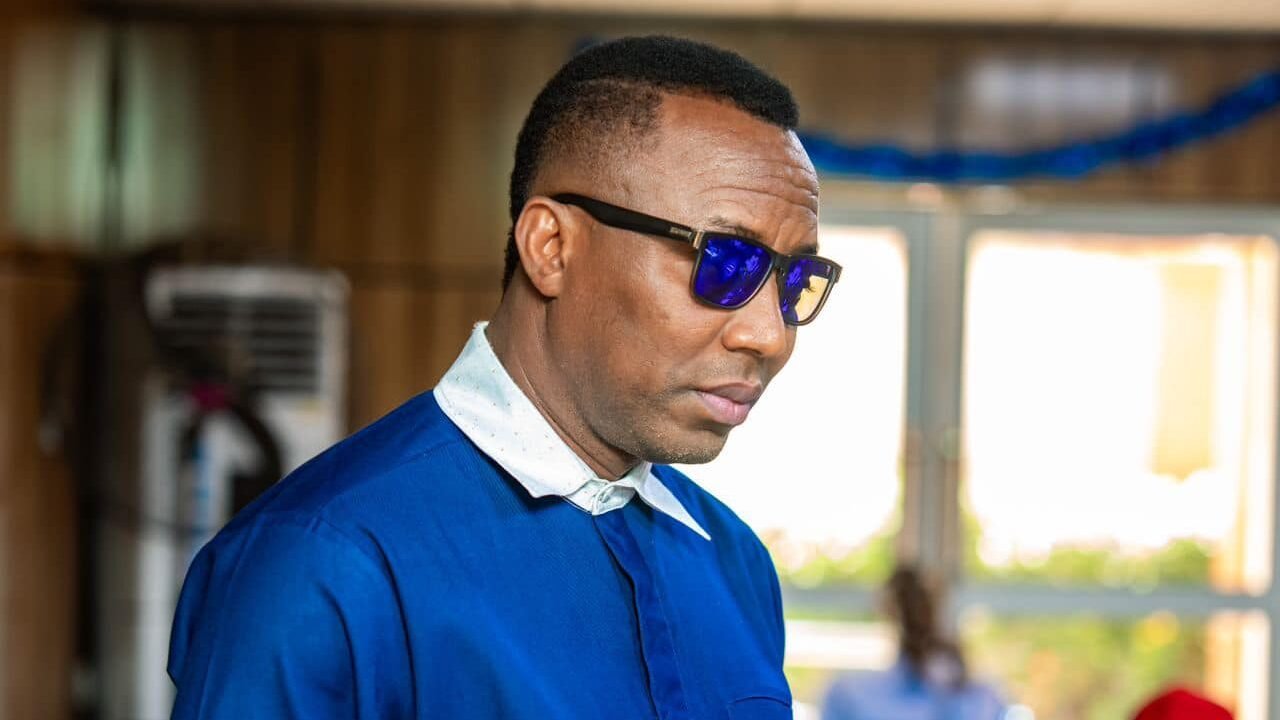
Tope Temokun, the lawyer representing human rights activist and Publisher of Sahara Reporters, Omoyele Sowore, has criticised the Attorney-General of the Federation (AGF) and Minister of Justice, Lateef Fagbemi, for outsourcing Mr Sowore’s prosecution to a private law firm.
In a statement shared with PREMIUM TIMES on Thursday, Mr Temokun described the move as part of a “dangerous pattern quietly taking root in Nigeria’s criminal justice system,” one that citizens seem to watch in silence.
The police filed the case last year, accusing Mr Sowore and Sahara Reporters of conspiring to forge a police wireless message dated 30 July 2025, to create disaffection within the Nigeria Police Force and incite officers against the federal government.
The case is one among several that the police filed against Mr Sowore during the two years plus tenure of Mr Egbetokun, whom Mr Sowore habitually referred to as “Illegal IGP” and accused of inept police leadership and of favouritism in promotion of police officers.
Letter served
Mr Temokun explained that while they were in court on Wednesday for the forgery trial, the police lawyer presented an authorisation memo from the Ministry of Justice, effectively handing over the prosecution to a private lawyer while the Nigeria Police Force (NPF) would cover the cost.
“The memo indicated that the Nigeria Police Force will bear the cost – meaning taxpayers will foot the bill for a private lawyer,” Mr Temokun said.

Mr Temokun questioned the constitutional and legal basis for outsourcing public prosecutions.
He noted that the criminal charge was originally filed under the former Inspector-General of Police solely because Sahara Reporters published a police wireless message.
“Criminal prosecution under Section 174 of the Constitution is a public trust exercised in the overriding public interest. When prosecutions originate primarily from alleged grievances of public officials, the Attorney-General has a continuing duty to review whether such proceedings still satisfy constitutional tests: public interest, interest of justice, and prevention of abuse of legal process,” he said.
Mr Temokun warned that state-funded outsourcing risks turning prosecutions into tools of political or personal retribution.
“Public prosecution cannot become an unlimited outsourcing arrangement at taxpayers’ expense without demonstrable national prosecutorial priority. The ongoing litigation involving multiple cases linked to criticisms of public officials highlights the urgent need for reform,” he warned.
He recalled that under the former IGP, almost every criticism from Mr Sowore sparked criminal charges, leaving the Federal High Court in Abuja with a backlog of FRN vs Sowore cases.
“Cybercrime legislation, originally meant to regulate speech, has been transformed into a tool under which citizens are hunted down and jailed by the police on behalf of the powerful.
“Every perceived word of disrespect becomes a charge. Courts turn into extensions of personal egos in top offices. If those offended had to pay personally, there might be restraint. But when taxpayers fund this, prosecution becomes unchecked,” he explained.
The case against Mr Sowore and Sahara Reporters has now been adjourned until 28 May.
Mr Temokun expressed hope that the new Inspector-General of Police, Olatunji Disu, would review and withdraw the charges.
He also urged the AGF’s office to develop clear prosecutorial guidelines to prevent criminal proceedings from being perceived as retaliatory and ensure prosecutions remain instruments of justice rather than extensions of administrative decisions.
“Prosecution must remain an instrument of justice, not merely a continuation of administrative decisions. The credibility of our criminal justice system depends not only on convictions but on restraint,” he said.
Mr Temokun referenced Sowore’s ongoing litigation against X (formerly Twitter), spotlighting the continued expenditure of public funds on politically tinged cases with little public benefit.
“The government rolls out tax reforms to raise revenue from citizens, yet funds continue to be wasted on politically motivated prosecutions. The new IGP must urgently review and discontinue these cases.
“This is not about Omoyele Sowore alone; it is about preventing state power from mutating into state-funded harassment. Nigerians are not mere subjects—they are owners of the Republic, and owners have the right to question how their money is spent.”
AGF’s media aide speaks
When contacted by PREMIUM TIMES on Friday, Kamarudeen Ogundele, the special adviser to the President (Communication and Publicity), office of the AGF, said although he could not immediately confirm the claim of engaging a private prosecutor for Mr Sowore’s case, the law empowers the attorney-general to make that decision.
While he refrained from commenting on the live case in court as “it is sub judice” to do so, he said aggrieved persons with complaints of violations of their rights “should go to court to seek a redress” instead of resorting to media campaign.
“It is also within the powers of the AGF to grant a fiat to a private lawyer to prosecute a case on behalf of the government. Examples abound. Let no one make a fuss of this,” he added.
He also advised our reporter to seek further information from the court.
Background
In August 2025, the police charged Mr Sowore and his platform, Sahara Reporters, with three counts, including forgery of a police wireless message dated 30 and 31 July 2025.
The police alleged that the defendants forged the wireless message with reference numbers CB:0900/IGP.SEC/ABJ/VOL 1774 and DTO: 301605/07/2025 and circulated it online to provoke the police and the public against the federal government.
Although, they did not contest the content of the message, they claimed the copy circulated by the defendants was a forged copy of the original version with numbers CB:0900/IGP.SEC/ABJ/VOL 177/174 and DTO: 301605/07/2025.
A notable difference between the two documents is in the sgement of the string of numbers starting with VOL. Instead of VOL 177/174 which the police claimed was on the original copy, the allegedly forged copy bore VOL 1774. In addition, they claimed that the signatures on both copies were different, tagging the signature on the copy published by Mr Sowore and Sahara Reporters as fake.
However, the message in the circulated copy is undisputed.
The wireless message dated 30 July 2025 reminded strategic police formations of the retired police officers’ protest against poor pensions that took place at the Force Headquarters in Abuja on 21 July 2025, and called for “fortification” of security around the force headquarters and police “TO AVOID REPEAT OF ANY SURPRISE” ahead of the second round of the protest. Mr Sowore played active roles in organising
The case has started before trial judge Emeka Nwite of the Federal High Court in Abuja.
Bassey Ibitham, a police officer with the Legal Section of the Force Criminal Investigation Department, stated in an affidavit filed along with the charges as part of proof of evidence, that although investigations were still ongoing, the police were ready to proceed with prosecution.
Sowore versus police
Mr Sowore, a Nigerian activist, former presidential candidate and publisher of Sahara Reporters, has faced repeated arrests, detentions and charges from the police and the State Security Service (SSS) over the years.
He was a fiery critic of theimmediate-past Inspector-General of Police, Kayode Egbetokun, whom he repeatedly referred to as an illegal IGP. This followed the tenure extension granted Mr Egbetokun last year through a controversial amendment to the Police Act.
Mr Sowore never desisted from referring to Mr Egbetokun as ‘Illegal IGP’ despite the charges the police filed against him in January last year over the claim and a recent court order obtained by Mr Egbetokun to restrain Mr Sowore from making “defamatory claims” against him.
Mr Sowore accused the IGP of incompetence, favouritism, and ineptitude. The police have consistently denied the allegations.
Before charging him in the wireless message forgery case, the police detained him in July last year for days.
Mr Sowore alleged that police officers harmed his right wrist in custody, although the police denied the allegation.
READ ALSO: Again, Maina’s absence stalls trial, judge threatens bail revocation
He described the arrest, which came on the heels of his active participation in the protest staged by retired police officers against poor pensions, as politically motivated.
The Nigerian police subsequently filed the three charges against Mr Sowore and Sahara Reporters.
A day before the arraignment, the judge, in a separate case, ordered six banks and financial platforms to release Mr Sowore’s account details and statements to the police. The Nigerian police requested the information for an ongoing investigation into what they touted as terrorism financing and money laundering allegations against Mr Sowore. But nothing has been heard about the case afterwards.