
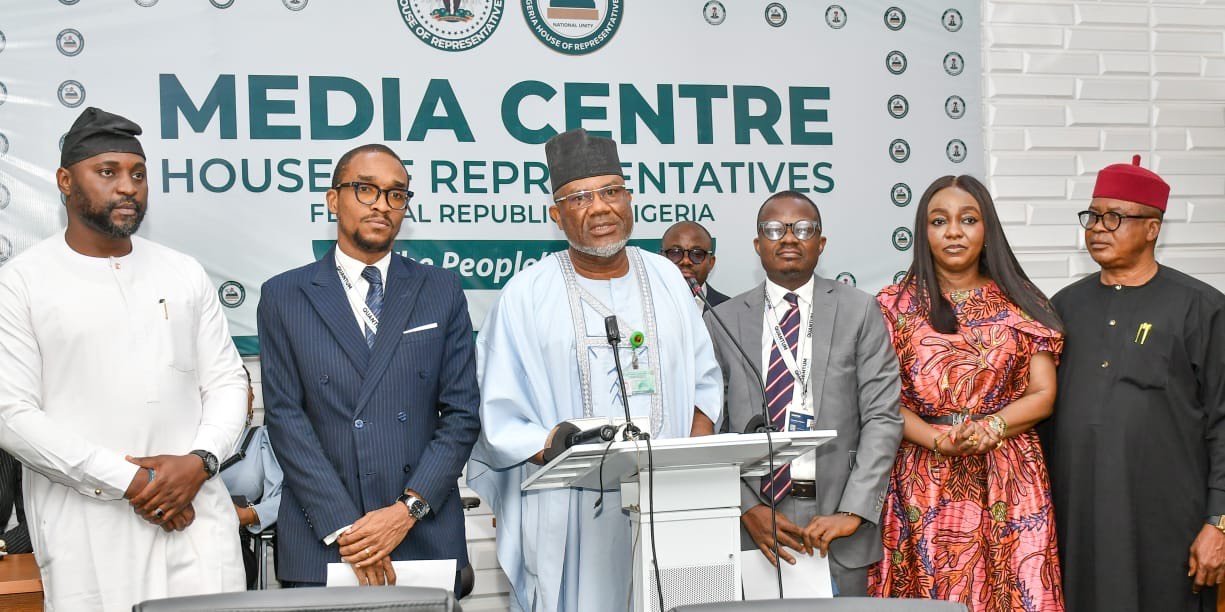
The Chairman of the House of Representatives Committee on Renewable Energy has announced support for the plan to establish Nigeria’s first dedicated Green and Climate Finance Bank, describing it as a strategic vehicle to unlock billions of dollars in climate-smart investments and accelerate the country’s transition to clean energy.
Speaking at a press conference in Abuja, the committee chairperson, Afam Ogene (LP, Anambra), said the proposed institution would mobilise long-term capital for renewable energy, climate-smart agriculture, green buildings, sustainable transport, waste management and other environmentally sustainable ventures.
He said the initiative aligns with the mandate of his committee to oversee renewable energy components across entities in Nigeria and to formulate policies that accelerate investment in clean energy technologies.
According to him, the proposed bank is conceived as a specialised financial institution focused solely on climate-aligned sectors, at a time when Nigeria is seeking to boost energy security through renewable sources.
“This initiative comes at a critical time in our nation’s history,” Mr Ogene said. “The question before us is simple: how do we unlock Nigeria’s climate opportunity? The answer is finance.”
Citing estimates by the International Finance Corporation, the lawmaker noted that Nigeria has a climate-smart investment opportunity valued at about $104 billion by 2030. However, he said conventional financing structures have struggled to mobilise capital at the scale and speed required to drive development in the sector.

He explained that commercial banks often consider climate-related projects high risk, making it difficult for renewable energy developers and green entrepreneurs to access affordable financing.
“It is not that the opportunity does not exist,” he said. “It is that the financial architecture to unlock it at scale remains underdeveloped.”
Mr Ogene clarified that the proposed Green and Climate Finance Bank is not a government-owned institution but a private sector-led initiative designed to operate in close coordination with national climate policies, renewable energy goals and regulatory frameworks.
He said the promoters have developed a detailed business plan, governance blueprint and stakeholder engagement roadmap, while engagements with regulators and development partners are ongoing.
Subject to regulatory approval and successful capital raising, the promoters are targeting commencement of operations in early 2027.
“As legislators, our role is to create an enabling environment,” Mr Ogene said. “We will continue to support policies that encourage renewable energy deployment, improve investor confidence and promote sustainable finance frameworks.”
He added that the House committee stands ready to engage regulators, development finance institutions and private investors to ensure alignment with national priorities and global best practice.
The lawmaker called on development partners, sovereign investors, pension funds and institutional investors to examine the proposal and collaborate with its promoters.
“Nigeria’s green transition is not optional. It is inevitable,” he said. “The only question is whether we will lead it or lag behind it.”
Founder of Quantum Partners and a lead promoter of the bank, Oluwafemi Adedipe, described the proposed institution as a platform to bridge the gap between green projects and capital markets.
He said Nigeria is among the most climate-vulnerable countries globally, facing floods, drought, desertification and energy insecurity, yet remains one of the most promising green investment frontiers.
“Opportunity alone does not translate into progress,” Mr Adedipe said. “The capital that will operationalise the opportunity must be mobilised. Risks must be structured and projects must be financed. That is the gap this Bank is designed to fill.”
According to him, the Green and Climate Finance Bank will provide flexible financing tailored to renewable energy developers, sustainable agriculture enterprises, green infrastructure projects and climate-aligned micro, small and medium enterprises, including women-led businesses and green innovators.
He said the promoters have spent months developing a comprehensive operating model and governance framework aligned with global environmental, social and transparency standards. An advisory structure bringing together expertise in banking, climate finance and investment management is also being assembled.
Co-founder Samuel Ndubuisi-Brown disclosed that the immediate target is to raise $100 million in founding capital.
He said the funds would enable the promoters to complete regulatory approvals, establish core systems and digital infrastructure, and commence lending and project financing.
While earlier timelines referenced 2026, he said the operational target is now 2027, subject to approvals and capital mobilisation.
“This represents a dual opportunity,” Mr Ndubuisi-Brown said. “Investors can be first movers in a market that is about to grow exponentially, while also supporting renewable energy expansion, green entrepreneurship, job creation and Nigeria’s resilience in the face of climate risk.”
ALSO READ: ANALYSIS: Climate change financing can help solve Nigeria’s petrol subsidy problem
Beyond returns, the promoters said the bank aims to build domestic institutional capacity for climate finance, reducing overreliance on external funding mechanisms.
They argued that global capital markets are increasingly shifting towards green and climate-aligned investments, and that early movers will shape the next era of economic growth.
The proposed bank, they added, would provide a home-grown platform capable of engaging international investors while understanding Nigeria’s economic realities.
“The green transition cannot be achieved by government alone, nor by the private sector alone,” Mr Adedipe said. “It requires partnership.”
If successfully established, the Green and Climate Finance Bank would represent one of Nigeria’s most ambitious attempts to create a dedicated financial vehicle for climate-aligned growth, at a time when the country is under pressure to meet its Nationally Determined Contributions under the Paris Agreement and strengthen energy security through renewable alternatives.